Select your language



- Industrial equipmentINDUSTRIAL PUMPING EQUIPMENTEQUIPMENT for ENGINEERING NETWORKSINDUSTRIAL PIPE FITTINGSINDUSTRIAL PUMPING EQUIPMENTINDUSTRIAL PIPE FITTINGS









Marine
Loading
Arms
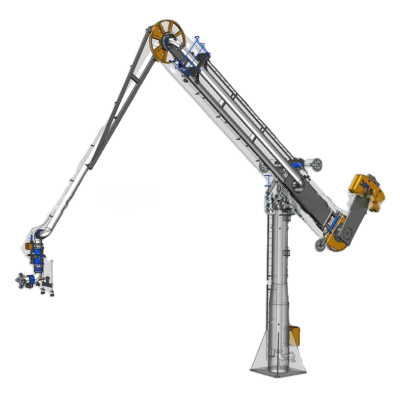
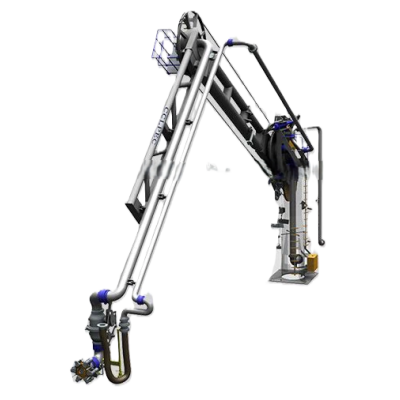
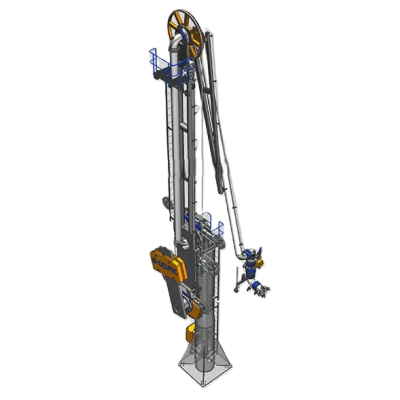
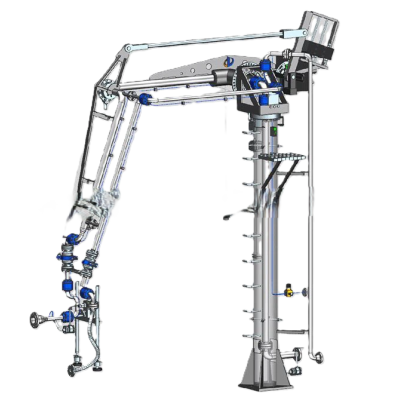

Marine cryogenic loading arm for LNG
Operating fluids: Liquefied natural gas, liquid ethylene, liquid nitrogen, liquid oxygen, other cryogenic media.
LNG loading arm
Size range
DN150 - DN400
Nominal pressure
2.0 МПа
Minimum temperature
-196°C
Maximum temperature
+80°C
Operating fluids
LNG
Certificates
-
The cryogenic marine loading arm is a special equipment specially used for loading and unloading cryogenic media between tankers and terminal storage tanks, such as -104 ° C ethylene and -163 ° C LNG. The LNG marine loading arm is equipped with protection against ice falling to ensure the safety of operator.
Technical Features:
The swivel joint is oil-free lubrication, and the raceway is purged with nitrogen to keep it dry. At the same time, the nitrogen seal can prevent the external water from seeping into the raceway and freezing.
The sealing of the swivel joint allows a transitory vacuum state.
The swivel joint adopts 2 layers of end face seal to ensure no leakage. For the 2 layers of sealing ring, 1 layer is main seal, and another layer is secondary seal. The test leakage is less than 10ml / Min / cm required by BSEN ISO 16904.
The seal of the swivel joint can be replaced on site without disassembling the arm.
Cryogenic double ball valve structure and PERC structure, using CCL patent design. When ERC cylinder fails, it can ensure that DBV will not separate.
The coordination between hydraulic valve blocks ensures that ERC cannot be disengaged before the double ball valves are closed, and the double ball valves cannot be opened before the ERC is fully tightened, ensuring the mechanical and hydraulic interlock. It is tested and certified, compliant with BSEN ISO 16904.
A wire net for falling ice is installed on the main line of cryogenic marine loading arm to prevent large ice pitons from falling onto the equipment and operators on the ground.
Marine loading arm for liquefied petroleum gas
Operating fluids: Liquefied petroleum gas, propane C₃H₈, butane C₄H₁₀.
LPG Loading Arm
Size range
DN150 - DN500
Nominal pressure
CL150, CL300
Minimum temperature
-46°C
Maximum temperature
+80°C
Operating fluids
LPG
Certificates
-
Liquefied petroleum gas, used as a working medium, is divided into gases with normal temperature and high pressure, as well as gases with low temperature and normal pressure. The pipeline material can be low‑temperature carbon steel or carbon steel.
Technical specifications:
It is used for transportation of liquefied petroleum gas, propane CHH₈, butane C₄h₁₀, etc.
A loading sleeve capable of simultaneously loading multiple liquids can be designed to work with volatile media, which allows for the simultaneous loading of liquids and gases.
The technical platform is used to carry out maintenance on the seals of rotary joints at the site of operation and is fully galvanized using the hot‑dip galvanizing method. The ladder is equipped with a fall protection system, which fully guarantees the safety of the maintenance personnel.
The surface of the marine loading sleeve is treated in strict compliance with ISO standards to ensure protection against marine corrosion, and the service life of the paint coating can reach 10 years.
At the base of the marine loading sleeve in the SVU unit, there is a manually operated solenoid valve. This unique design ensures that loading processes will not be disrupted in the event of a PLC failure.
The design of the swivel joint includes a double seal, which makes it easier to replace the seals and significantly reduces leaks compared to the requirements of standard specifications.
The main steel structure is made of ASTM A36 or Q345B steel. This material is easy to weld and has good mechanical properties.
Hinge joints can be disassembled and reassembled individually in any position, which simplifies the process of repairing and replacing hinge joints.
Gasoline and Diesel Marine Loading Arm
Operating fluids: Gasoline, diesel fuel.
Gasoline Loading Arm
Size range
DN100 - DN500
Nominal pressure
CL150, CL300
Minimum temperature
-19°C
Maximum temperature
+200°C
Operating fluids
Gasoline
Certificates
-
The main components of a marine loading arm include: a riser, a trunnion assembly, a support structure, a pipeline, a balancing gear mechanism, a counterweight system, a triple swivel joint, a swivel joint, an emergency release coupling (ERC), a hydraulic/manual quick-disconnect connector (QCDC), a hydraulic power unit (HPU), a solenoid valve unit (SVU), a local control panel (LCP), a position monitoring system (PMS), etc. The pipe material is selected in accordance with the properties of the medium to ensure a corrosion safety margin.
Technical specifications:
It is used for loading and unloading petroleum products, including gasoline, diesel fuel, HSD, PD, G92, G95, G97, etc.
Each marine loading arm is equipped with six swivel joints, providing six degrees of freedom of movement. One isolated swivel joint prevents static electricity between the pier and the tanker. A grounding system is installed at the bottom of the marine loading arm column, and antistatic tapes are installed at both ends of all swivel joints and flange connections.
The ERC system, equipped with a double ball valve, allows for quick and safe closure of the connection to the tanker in an emergency.
The cables of the drive systems comply with the technical requirements of GB/T8918, and the safety factor exceeds 5, which surpasses the OCIMF requirements.
At the top of the marine loading hose, there is a nitrogen purge system installed to remove any remaining working medium from the main pipeline after loading and unloading are completed.
The ERC system allows for quick closure of the upper and lower ball valves and disconnection of the annular gate, ensuring complete safety and reliability in an emergency situation or when the vessel drifts beyond the permissible parameters of the marine loading hose.
Chemical Marine Loading Arm
Operating fluids: Acetonitrile, methanol, ethanol, sodium hydroxide, etc..
Chemical Loading Arm
Size range
DN100 - DN500
Nominal pressure
CL150, CL300
Minimum temperature
-19°C
Maximum temperature
+200°C
Operating fluids
Chemical substances
Certificates
-
The marine loading sleeve is installed on a pier or floating dock and is used for loading and unloading liquid between a tanker and the receiving station’s tank. Compared to a loading hose, the marine loading sleeve is a rigid tubular structure that is not easily broken and has a longer service life. The pipe material is selected in accordance with the properties of the medium to ensure corrosion resistance.
Technical specifications:
It is used for loading and unloading chemicals such as acetonitrile, methanol, ethanol, sodium hydroxide, and others.
The QCDC (Quick Connect Coupling) of the triple swivel joint of the offshore loading hose is connected to the tanker’s manifold flange, and the other end is connected to the flange of the onshore pipeline.
An independent supporting structure; the entire load from the main pipeline is supported by a steel structure.
The supporting structure of the inner lever is a frame‑based structure, which, unlike a box‑type structure, effectively reduces wind load.
The design, which ensures balancing without a load, allows the marine loading arm to maintain its balance in any position.
The CCL swivel joint design features two guide channels that meet the requirements of the OCIMF standard.
The hydraulic quick-connect coupling allows for a quick connection of the MLA to the tanker’s manifold flange.
For chemical media with high viscosity, equipped with electric or steam heating systems.
The external load is supported by a support system that improves the stress state of the rotary joint and reduces the likelihood of leakage.
Concentrated acid Marine Loading Arm
Operating fluids: Hydrochloric acid, sulfuric acid, nitric acid, etc.
Acid Loading Arm
Size range
DN100 - DN500
Nominal pressure
CL150, CL300
Minimum temperature
-19°C
Maximum temperature
+200°C
Operating fluids
Acids
Certificates
-
Concentrated acids typically have high corrosive activity, and some of them also possess other properties, such as strong oxidizing and dehydrating capabilities, which can cause severe chemical burns in humans. Choosing the right anti‑corrosion material and connection method for a marine loading hose will provide customers with more efficient and safe operation.
Technical specifications:
It is used for loading and unloading acidic media, such as hydrochloric acid, sulfuric acid, nitric acid, etc.
The material can be selected depending on the environment: for example, 316L, 316Ti, alloy steel, cast iron, carbon steel with PTFE lining, etc.
Drain holes in the lower part of the column and the triple swivel assembly allow liquid to be drained from the marine loading hose.
The triple swivel joint is equipped with an adjustable jack to absorb the load on the collector flange, which arises due to the marine loading lever.
A vacuum interrupter with a spring return mechanism can be installed at the top of the marine loading hose. After loading and unloading are completed, the operator opens the vacuum interrupter by pulling the rod in the triple swivel joint.
The internal and external movement of the boom, as well as the horizontal swivel movement, are carried out using a hydraulic device. Marine loading booms with a diameter of 12 inches or less can be designed for fully manual control.
The pipeline system and the support system are connected by flexible joints. The pipelines bear only the pressure and weight of the working medium. The weight of the pipeline is transferred to the support system through flexible support points located along its entire length, which reduces the load on the pipeline system and the swivel joint, thereby minimizing wear and leaks.
It is recommended to use a hydraulic QCDC to reduce the likelihood of operator contact with the liquid and to increase the level of protection.
LNG Bunkering Loading Arm
Operating fluids: Liquefied natural gas
LNG Bunkering Loading Arm
Standard
BS EN1474.1-2008
Nominal pressure
1.6 MPa
Minimum temperature
-196°C
Maximum temperature
+65°C
Operating fluids
LNG
Certificates
-
Changlong independently developed and implemented an LNG bunkering arm, which is installed on a pier or tanker and is used to refuel vessels operating on LNG. The LNG bunkering arm has a rigid connection, and each of the hoses supplying gas and liquid is equipped with disconnecting couplings. If the connected tanker accidentally leaves the work area, the bunkering arm will automatically disconnect from the vessel, making the entire LNG refueling process safer.
Currently, many berths still use loading hoses, but due to the specific distance between the berth and the vessel, as well as the labor‑intensive nature of the connection process, the hoses are difficult to connect. Moreover, compared to rigid pipes, the hoses are prone to breaking, which makes their service life relatively short. The new bunkering sleeve for LNG that we have developed helps to avoid these problems. It has the advantages of ease of use, rational design, and reliable operation.
Technical specifications:
The design of the loading lever is a lever mechanism that ensures the balance of movement.
The loading sleeve is equipped with an emergency disconnect connection and an alarm system to ensure safe operation.
The cryogenic swivel joint of the loading arm is a patented development by Changlong, representing a cutting‑edge product in the industry.
The loading sleeve is equipped with a locking mechanism for resetting the lock in the off state.